 Otiato Guguyu
The seven o’clock flight slides into Kisumu from Nandi Hills just about the time the sun breaks the horizon in the West and lights up the city crocheted into the dark greenery of receding night, with the plane landing on a stretch of tarmac on the northeastern tip of Lake Nyanza, its roar running late by a few seconds.
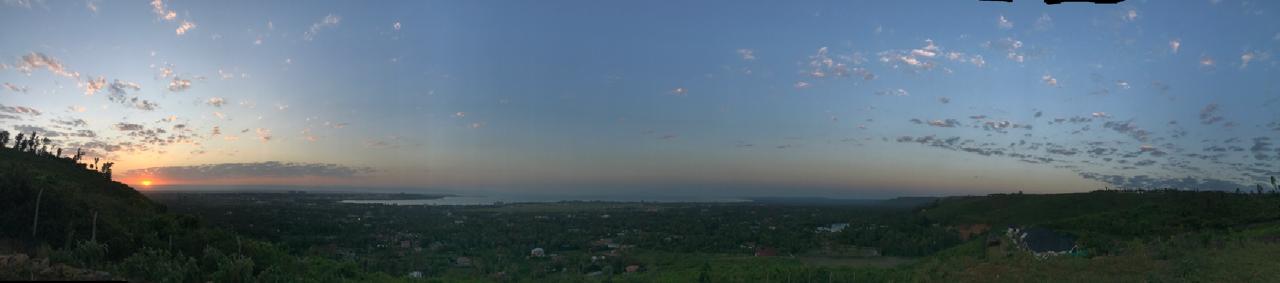
I have seen this flight each morning I have been able to catch the sunrise on top of the series of Riat hills, but this time round, I had to wait for it at the foot of the hills, at the airport. I was meeting a Nairobi crew where I was to provide camera support for French AI tech leader, Olivier Gomez on a trip to Shianda village in Western Kenya to see firsthand JitumeDigital Hub, an outpost that is supposed to deliver AI to the village.
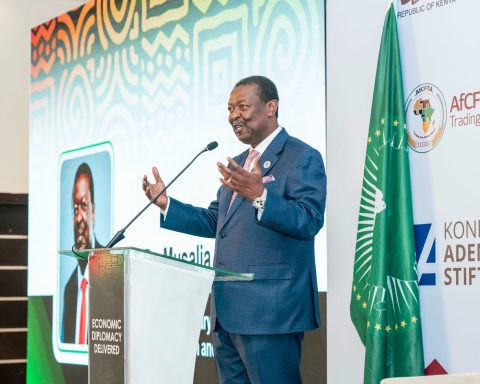
Read also: Mudavadi urges Luhyas to capitalise on the digital superhighway, they ask for electricity
This experiment in the backyard of Prime Cabinet Secretary Musalia Mudavadi’s hometurf is a key state effort to bridge the digital divide and accelerate the country’s digital transformation in rural areas. It is supposed to expose young people in rural areas to online jobs like data entry and annotation, crypto and betting.
According to the government, the “Jitume” program, which aims to equip young people with digital skills and create employment opportunities has already facilitated 450,000 jobs, with a target of reaching 1 million.
Huawei Kenya played a key role as a technology partner connecting the hub to the government’s high-speed fibre-optic network (NOFBI), installing eight Wi-Fi access points for campus-wide coverage, and equipping the facility with a smart screen to enhance teaching.
For a digital corporation like Huawei, this was a win-win partnership, given the ambitions of the telecommunications industry to expand internet usage to a quarter of the world’s population, the over 2.2 billion people currently with no access. That meant going into rural Kenya.
I had previously given support to the Huawei team during the launch of the digital Hub in Shihanda. And they gave me another shot this time as part of their crew due to an incident that had left their core team indisposed.

They caught me just outside the airport, and we set into Kisumu at the hour when the sun slants on tarmac and greenery and reflects water on everything. After a short stop in Art Café, where the order came late on large frost glass plates and miniaturized servings, we left for the hills towards Kakamega.
The one-and-a-half-hour-long trip is completely comfortable on a stretch of smooth tarmac and plush of consistent greenery, so that everyone remembers the sleep they had to bag up to catch the morning flight on time.
Villages wake up to markets and transport nodes, and that daring boda boda with stacks of tomato cases piled up above his head races past us, blasting music mounted on his Bajaj bike. Olivier, a biker himself, notices. He later shows us he has done a bike trek around the entire island of Mauritius, the entire country roads is sand and mud, compared to here, he says.
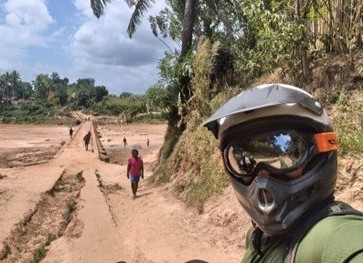
He asks if Kenyan motorcycles have colour-coded rules, noticing they have these gaudy yellow helmets. We explain to him that these are boda boda transport, and the choice of colour is basically driven more by costs. This yellow, black and white batch are the cheapest available in town.
While we follow Google maps that lead us up to Shihanda town, a little transport node, and a village market that looks like just the previous one, I advise them to ask a local and not rely fully on maps. From experience, the choice of the shortest routes for maps may not correspond with their state on the ground and you may get stuck on a country road for longer. The local villager, always eager to give directions can always be relied upon to give the route that works.
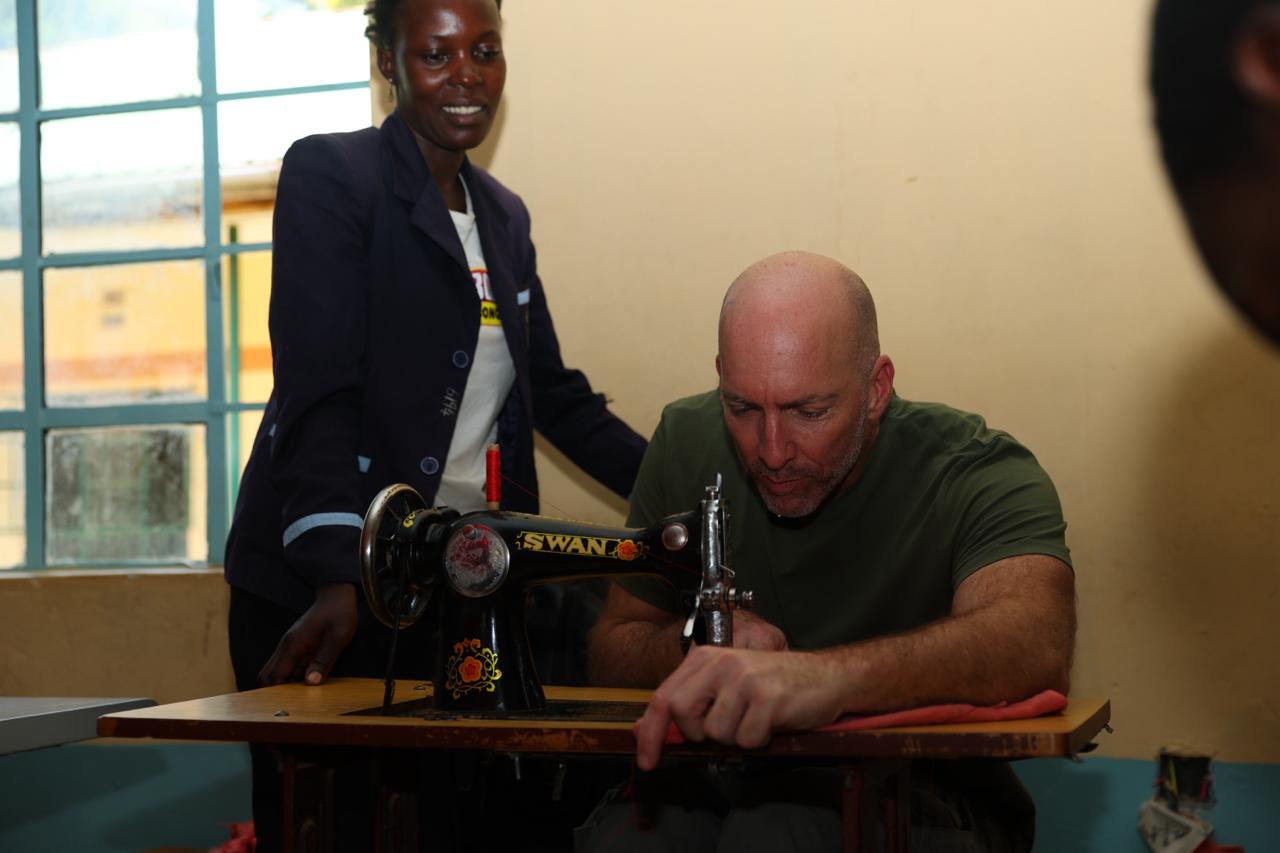
At the polytechnic, we meet the student,s two of whom are in session at the computer lab. Olivier is engaging. He sits with them and asks what they were doing, and proceeds to help them with the task as other students file in to listen to the tech entrepreneur, the OG in real life.
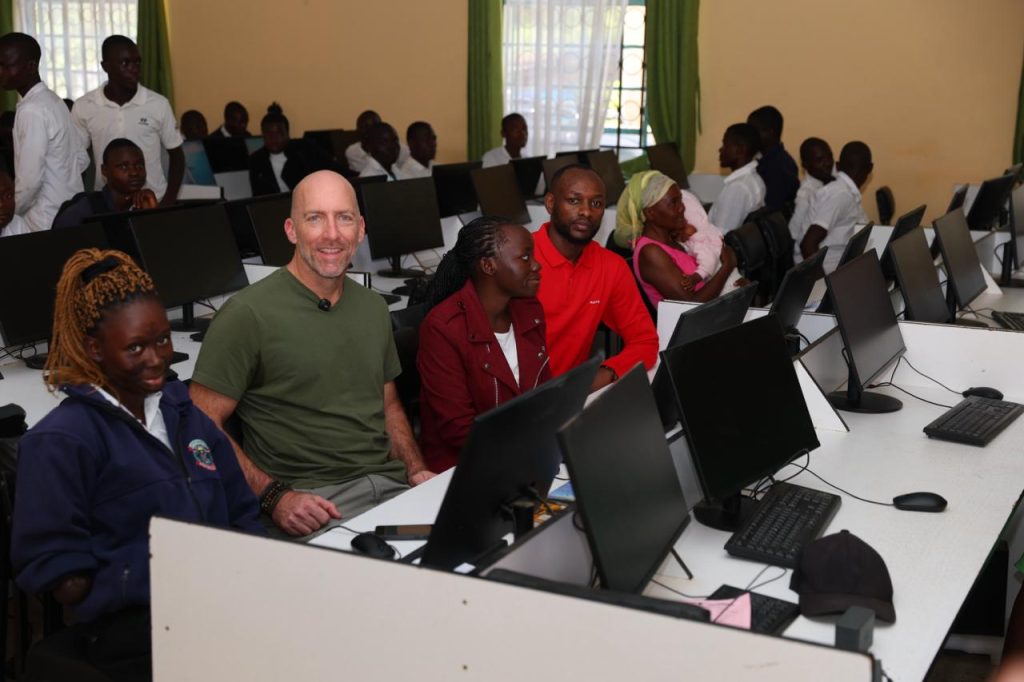
Olivier is bluntly logical in his speech and tells these young villagers that in this new economy, companies are basically shopping for the least cost of labour to provide basic annotation and complex coding skills amongst a large global pool, which means geographical location does not matter anymore.
But when they tell him their challenges, he realizes it might still. Their connection is intermittent despite being provided by the state infrastructure, as well as power fluctuations. They were also prone to internet fraud that is eroding trust, especially with Artificial Intelligence, which is growing deepfakes.
“I did a job for some Indian company which was to photograph different furniture, and after a lot of work, when the time for payment came, they told me they do not work with Kenya as a jurisdiction, and I never got paid,” the instructor said.
Olivier said that fraud is a big issue which will inevitably be compounded by the rise of AI. But AI also possessed the tools to sift through the deluge of fake and to find real versions. This, he admits, will be cost-prohibitive.
This means that most of us will need to cultivate personal skepticism to navigate this new world.
The village boys and girls were still grappling with the basics, but were quickly learning how to use AI, including drafting better curriculum vitae, leveraging social media marketing for their technical vocation in masonry and plumbing, as well as new ideas of executing projects on the ground. A local government official also used the center to upload data for the state digital fertilizer distribution project and keep track of disbursements.
On our way back, we stopped at Maseno, where the Equator crosses at 0 degree,s and the imaginary line is marked here with the Lions’ Rotary Club yellow globe and a line of bricks marking the trail on one side with two huts on the opposite side of the road, one in each hemisphere. A local guide shows us the line is not as imaginary as we think. With a trickthat cost us three hundred bob, he shows us the gravitational pull on water moving clockwise and counterclockwise across the hemispheres.
Later, we pay homage to Lake Nyanza and only missed the sunset on the water because they had to catch their flight out of Kisumu. But he is awed by the waters, even tempted to miss his flight for a ride on the beauty. I tell him how big she is, the size of Scotland and the most violent in the world, taking 5000 men each year.
I tell him I think AI will come into conflict with fresh water like her, but he thinks it is the energy to power the technology. He speaks of Elon Musk as almost messianic in his quest to break this limit by sending his AI powered satelites into space to access the energy of the sun without the insulation of the ozone layer.
I tell him the Sun, my master, tends to incinerate all who approach him and his flares have already been raining down Elon’s space junk.
When he asks about our religious inclination here, I tell him official data says Christians make up about 87 percent, the Muslims are about 11 percent, and the others like me, who figure the world is split between ancestor worship and animism. The theory is simple, once upon a time, one of the great ancestors, Abraham, Jesus, Mohamed, Budha, etc discovered the divine truth, and for that, the world must follow him.
I, for one, do not have a dispute in their truths or claim to divinity, but they are not my ancestors; I follow mine, who followed the Sun.

Discover more from Orals East Africa
Subscribe to get the latest posts sent to your email.