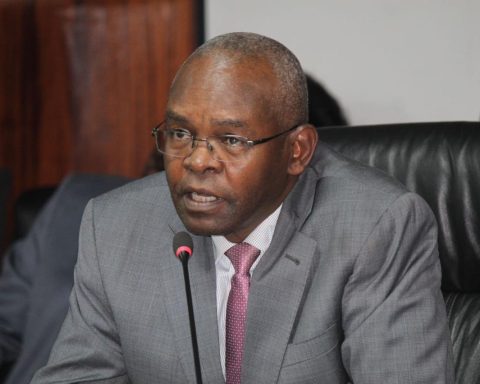
Otiato Guguyu
Kenyan banks have been given just two days to review loan interest rates on shilling-denominated debt in line with a new benchmark anchored on the overnight interbank average rate, now renamed the Kenya Shilling Overnight Interbank Average (KESONIA).
CBK announced Banks have up to September 1, to adopt this new universal base rate, above which they can add a premium based on cost of funds, return to shareholders, and client risk. Banks will also add fees and charges on the rate.
The move is a significant shift from the current state where each bank has its own base rate, which are voluntary adjustment to the Central Bank Rate, a trend that has made it difficult for the CBK to signal loan costs.
Read Also: Earning season, when banks stop lending
Churchill Ogutu, an Economist, IC GROUP says the regulator is attempting to create a unified base rate, which is good for the banking system, given each bank charged its own independent rate.
Link to transactions
He says other countries like South Africa have a similar standardized prime rate, a few basis points above their repo rate which operates as our CBR, guiding bank loan pricing.

Mr Ogutu said that it may however, introduce a level of uncertainty, especially since the rate is compounded monthly, meaning banks will only know at the end of the month how much they are charging clients.
For investors, the shift on banking counters will follow lenders internal efficiencies and cost structures since they will now be restricted to the same benchmark.
“Right now banks and their customers sort of know how much will be deducted every month, but now they will have to wait the end of each month to get the average Kesonia,” Mr Ogutu said.
He said Kenya seems to be moving along the global shifts where the benchmark rates are being benchmarked on the transactions in the market.
In the developed market banks have moved from the London Interbank Offered Rate (Libor) a projected rate to the Secured Overnight Financing Rate (SOFR) which tracks daily rates.
Cheaper loans
The Central Bank of Kenya is reviewing the benchmark signal to get banks to lower interest rates.
When CBK governor Dr Kamau Thugge raised interest rates to 13 percent, to curb inflation banks were quick to raise their rates in tandem.
However, as the regulator re-adjusted policy and began cutting rates to signal banks to cut their loan costs, they have been hesitant.

The regulator has accused banks of ignoring the signal rate after cutting rates seven times over the last year to reduce the cost of loans.
Despite the CBR coming down to 9.5 percent average commercial banks’ lending rates declined slightly to 15.2 percent in July 2025 from 15.3 percent in June, and 17.2 percent in November 2024.
This has delayed recovery of the economy which had slumped when interest rates were raised resulting in shrinking private sector credit at the beginning of the year.
Lending to the private sector stood at 3.3 percent in July 2025 compared to 2.2 percent in June, and -2.9 percent in January 2025.
New rate cap
The delays in transmitting lower rates to the public risks rising anti-banking sentiment that preceded the capping of interest rates in 2016.
Before the rate cap was imposed, the Central Bank of Kenya had introduced the Kenyan Bakers Reference Rate (KBRR) which gave a recommendation but allowed banks to top off with their perceived risk.
KBRR, which was calculated as an average of the CBR and the two-month weighted moving average of the 91-day Treasury bill rate.
Banks largely ignored the rate and charged exorbitantly, which led to the call to have a ceiling that eventually introduced the cap.
Now again, MPs are stoking populism in promising to cap interest rates charged by loan sharks. Embakasi MP Babu Owino has promised to introduce the Micro Finance Fair Credit Bill of 2025 even as legislators to with several attempts to cap lending rates.

Discover more from Orals East Africa
Subscribe to get the latest posts sent to your email.