Mzembe hits the jackpot “Mimi ni Omwami!”
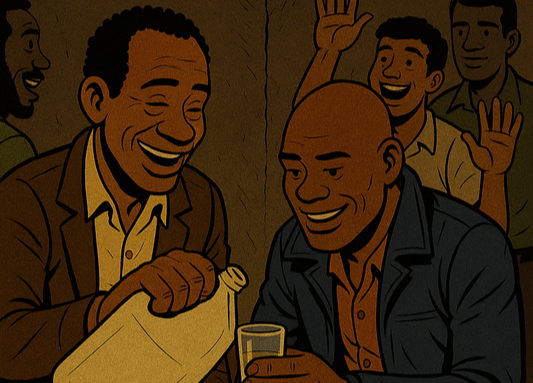
Now that he was home for Christmas our boy was flossing, living like a king. Whenever him and his fellow con, Bongisa, popped into the village pub, Kimberly, the barmaids abandoned the tired village teachers and tea farmers who nursed a beer for an hour and gave no tip and swarmed around their table.
Mzembe and Bongisa were the real money; mint-fresh city money that came out of a leather wallet, and not those crumpled fifty notes and grimy coins that the village cattle traders carried in their pockets.
But Mzembe and Bongisa had not come all the way from the city to drink Tusker beer at Kimberly. They had left enough of that in the city. In any case, much as it was a posh village joint that was powered by electricity, a rarity in the village at the time, thanks to the proprietor’s investment in a noisy generator, Kimberly Pub didn’t have a live band and a dancehall like their usual weekend watering hole, Muungano in Eastleigh. For this reason they found it more entertaining to hang out in the busaa joints in the neighbouring Idakho villages, where the villagers beat wild stories as they sipped their drink out of rusty Kimbo and Blue Band tins. The ladies were equally wild and willing. For a kilo tin of busaa you could disappear with one inside the bushes in the trees encircling the drinking place and get your heart’s desire.
This was the kind of life that got Mzembe’s blood bubbling in his veins whenever he came to the village, and not perching on a bar ‘sina tabu’ stool quaffing Tusker beers in staid stiff-lipped working class company.
Read also: How Mzembe escaped a ten thousand shillings fine, ‘I went to college in Nairobi’
One such day, after a lively Sunday evening in a busaa den in Shichiko, Eregi, dancing to isukuti music with crafty village ladies, our boys ended up in a chang’aa joint in their village where they planned to watch the sun set. It had rained heavily, and it had been tough work hauling themselves out of the valley on the muddy cattle-track that passed for a road; but then they had fortified themselves well on the wicked fried pork and matumbo that was served at the busaa joints in Shichiko and had the energy reserves to party all night, if need be.
When the village lads saw our two city boys with their muddy wing-tipped shoes and wet fashionable city jackets their faces lit up, and they scrambled to find them the most comfortable sitting places in the dimly-lit hut since they knew that these boys didn’t joke when it came to money; and that they didn’t buy their drinks in five-shilling measures like ordinary village layabouts.
And so Mzembe and Bongisa, comfortably seated, with one of the star-struck villagers cleaning the mud off their shoes outside, bawled at the mama pima to put a five-litre jerrican on the table for the party to begin. A loud cheer went up around the darkened hut. As for the serving mama, she hastened to fetch her patrons the special cut glasses that she reserved for Christmas guests, slapping a smoky kerosene koroboi lamp on the table for them to see as they poured. The party progressed well, with the tales turning bawdier the more jolly the boys got. It was as it was darkening outside with the crickets taking up their call that the front door pushed inside and an unusual visitor loomed in the entrance.
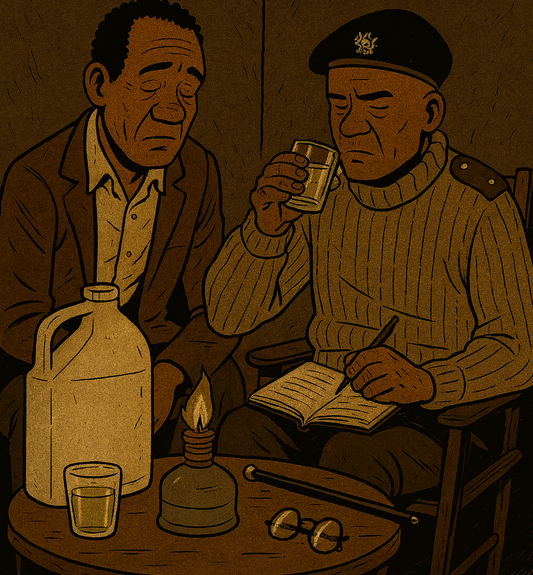
He was a slight man in a thick tan epauletted sweater and black beret that had the shiny crown of the Republic of Kenya at the front – the area Assistant Chief.
He stood there a while, sweeping the little gathering with the stern piercing gaze they are trained to assume at Administration School – or wherever it is government administrators are trained. Ordinarily, even though conversation had ceased, the party would have long broken up, with the drinkers scattering through the back entrance and the tiny windows of the hut. Reason being, what they were drinking was what the government called ‘pombe haramu’, and if you saw the government coming you had to scatter.
But then no one shifted when this government fellow turned up, with his silver-tipped swagger stick clutched under his arm. They knew well why he was there. For one to wet his parched throat after a long day doing government business.
“Simama Kijana!” he barked at the village carpenter who was seated close to the door, pulling him out of his chair by the scruff of his collar. “Huna heshima kwa serikali? Unajua mimi ni Omwami?”
A round of giggles met this strern reprimand. After he had settled in the smoke-stained folding chair he took off his beret and placed it on the table together with the black cane. Then he took out a handkerchief and wiped his moist bald pate, hawking authoritatively the way he usually did at the Chief’s baraza before he proclaimed punishment for an errant youth who had been brought before him. As if on cue the mama pima appeared from the dancing shadows and placed a clean glass on the table, smiling a ‘karibu!’ at her unusual guest. Still hawking, and with a serious frown on his face, the Assistant Chief proceeded to pour himself a drink from the now half-full jerrican on the table without the owner’s invitation. He then leaned back, raised the glass, and gulped down the fiery contents in one long drag like a pro.
After he had poured and knocked back half the contents of a second glass, he finally sat back, wiping his lips off the back of his hand, smacking as if he had just swallowed chloroquine. “Ni kali sana leo,” he remarked to no one in particular, drawing a palm-sized hard copy notebook, a biro and his spectacles from his breast pocket and preparing to run through the list of errands and tasks lined up for him the following day in the yellow light of the lantern. “They must have added bangi to the brew!”
The boys sniggered and went back to their conversation. For a while there Mzembe’s hackles had stood up at the effrontery of the little man, inviting himself to their drink without permission, but the guy seated opposite had winked at him and signalled at him to let it pass. He was a welder who plied his trade at Stand Kisa, and who was dressed in faded, paint-stained overalls, his toolbox at his feet. He had an early job to finish for a client in the village before he headed off to work the following day.
The drinking continued steadily, and the bawdy tales got funnier the more inebriated the boys became. Seeing the jerrican almost depleted Mzembe signalled the mama pima and asked her to add in a ‘green’ – a two-litre measure.
Seeing the jerrican replenished, the Assistant Chief downed his drink and helped himself to another – now his fifth – before he resumed grunting and doodling in his notebook.
Meaning by the time they were ready to leave, the “mimi ni Omwami”’s now came out in a slurr. It had stopped drizzling outside when Mzembe paid the bill and they stepped out into the night.
By then the Omwami was thoroughly stoned on the free drinks he had been helping himself to, courtesy of his city subjects. He could barely stand up straight, his eyes glazed over. Someone helped him put on his beret, then they handed him his swagger stick and they staggered off on their way home.
“U-u-un-naj-jua m-mimi n-ni Om-mwami?” he reminded everyone, sliding and almost losing his footing on the slippery village path, holding onto Mzembe’s wrist for support. “K-kij-j-ana, ng-g-oja k-kwanza Om-m-wami ak-k-ojoe!” he ordered, halting the party so that he could hose the pathside bushes with piss.
The bemused lads, who were stoned as newts, watched in silence as they quietly hatched up a plan. They were going to teach the administrator a few lessons about living off freebies like a tick, using the crown the Government of Kenya had given him as a chambo – a fishing rod.
The welder had half a paint of tin, the red oxide that he needed to paint on the welded steel after work the following morning to prevent rust. He removed it from the box and got it ready.
As they staggered on home, they had to support the unstable old man along because his feet could no longer find purchase in the mud. Several times they let go and he went tumbling into the ditches, and they had to help him out again. By then, his once neat official sweater was covered in mud, same to his beret, which they had to keep fetching from the ditch with the help of a cigarette lighter whenever it fell off.
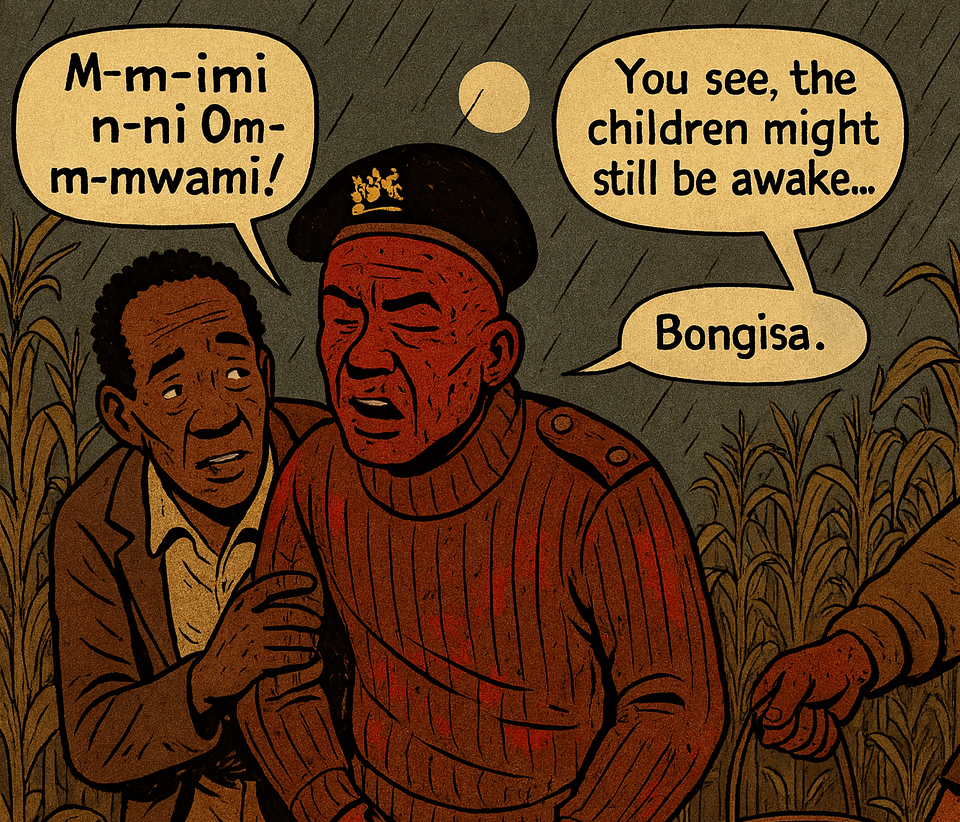
But it was not just mud that was caking his official uniform. As the boys helped the inebriated old man along they were slathering him in a generous layer of the red oxide paint, helping themselves to the welder’s open tin. By the time he sobbered up in the morning he was going to discover that he was slathered all over in fast-drying red paint, including on his face and all over his bald head, right into his ears.
As a bonus, when they approached his boma they decided to lead him home through his maize field instead of approaching by the gate.
“You see, the children might still be awake and might see you covered in mud,” cautioned Bongisa.
“M-m-imi n-ni Om-m-mwami!” he grunted in response.
By then, with Christmas round the corner, the fields were ready for harvesting, and inside the rows of golden-brown maize stalks were lots of sticky weeds, mostly the forget-me-not rogohe weed. Meaning that by the time they eventually deposited him at his doorstep the old Omwami was not only wet and stained red and brown all over, but he was also covered in thick burr and bumbles from head to toe. Mzembe and the boys knocked once and then let him slump down against the door before taking off into the night.
It was only when he came out of his stupor the following morning that in his befuddled mind he remembered there was an important DO’s baraza that he needed to attend at the village school, and which he couldn’t evade, with him being the host. And, even more crucial, this was the worst time to be fired for absconding duty now that he had just a couple of months to retirement. That would mean losing his benefits.
What?
The household went into a frenzy. Since he had only one official sweater and beret, the wife had to do her best to make it presentable using steaming rags and a coal iron box. But even worse awaited him when he went to the bath shelter behind the kitchen for his morning bath. While the mud could be washed off with hot water, the red paint couldn’t, however hard he scrubbed.
Meaning despite his wife’s best efforts, when he eventually turned up at the DO’s baraza he presented quite a spectacle. And was still reeking of the stuff that had made him merry last night, despite chewing njugu and some eucalyptus leaves in an attempt to cover up, his eyes bloodshot.
The DO, who was already seated – a breach of protocol – gave him a sharp look as he saluted, bowed and shuffled to his seat. He then leaned and whispered to the openly shocked area Chief, who was seated to his right.”The things I have been telling you about. It is good that he is proceeding on retirement. Let’s hope he holds out and doesn’t force anyone of us to write that letter. The wife would never forgive me. She is of the clan.”
Meanwhile Mzembe and his friends, tucked in the flower bushes around the clearing, were thoroughly amused as they followed the well-attended public meeting, just barely restraining themselves from bursting into laughter.